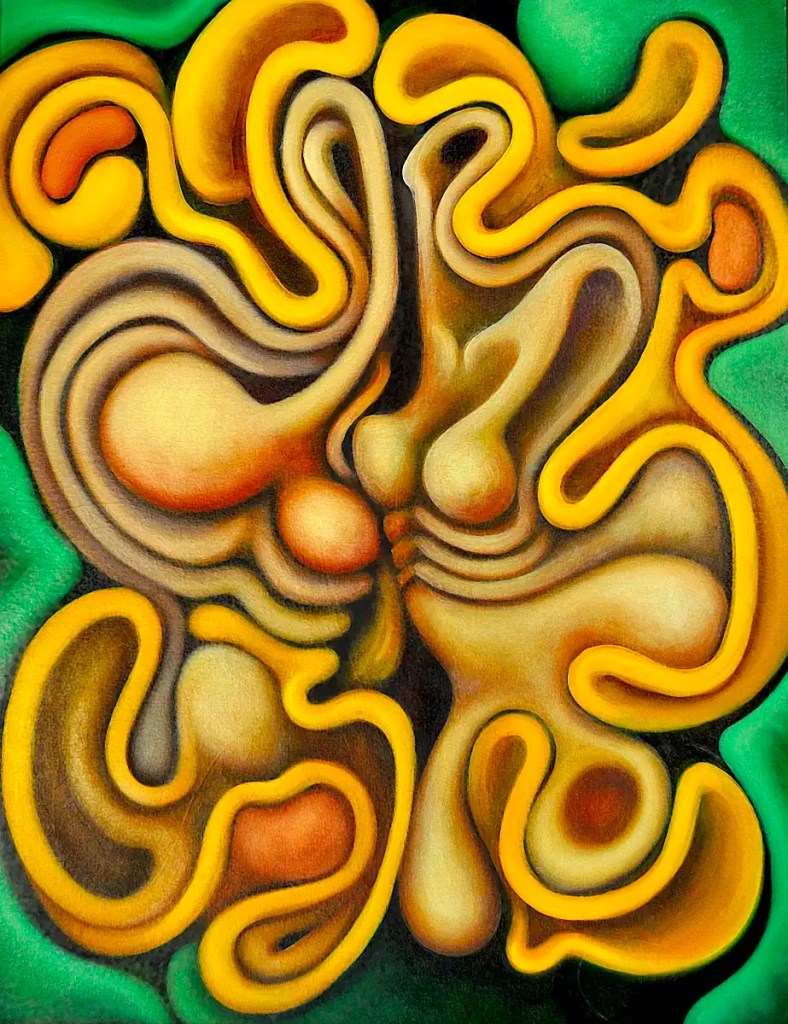
I’m sure that it’s obvious that this is two butterflies, umm… “dancing”. It’s 24×18… oil on panel.
I’m sure that it’s obvious that this is two butterflies, umm… “dancing”. It’s 24×18… oil on panel.
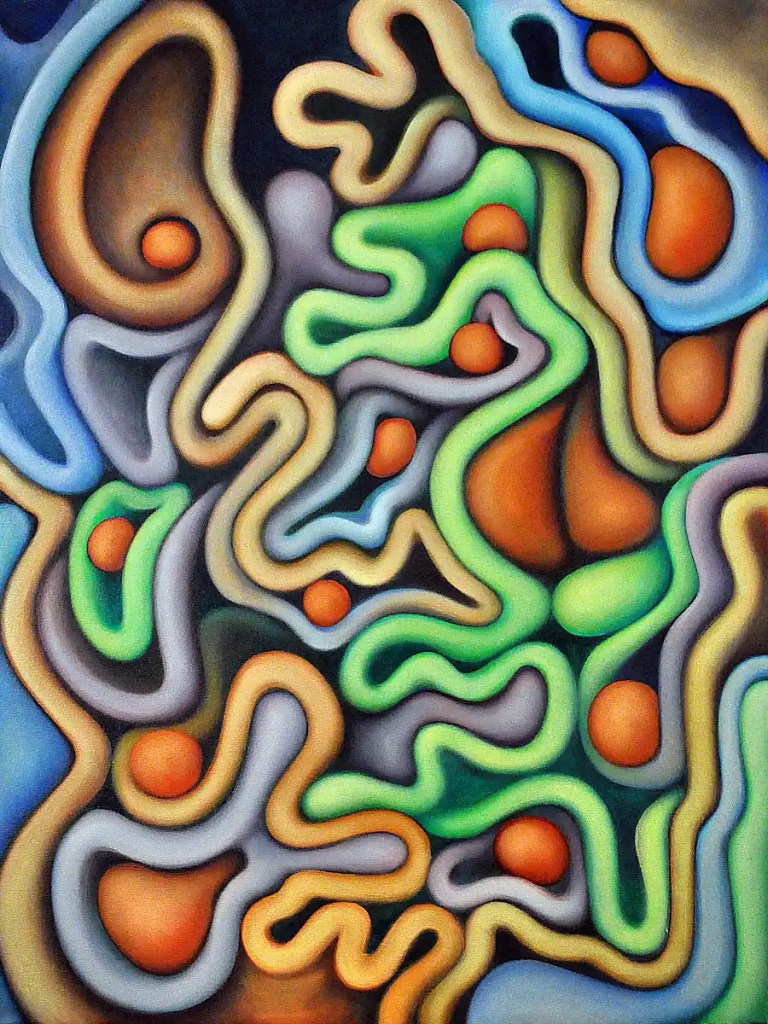
I went ahead and scrubbed the highlights into this painting… extremely thin applications of Sennelier’s Naples Yellow and Titanium White.
This goes to the Collective Gallery this weekend…
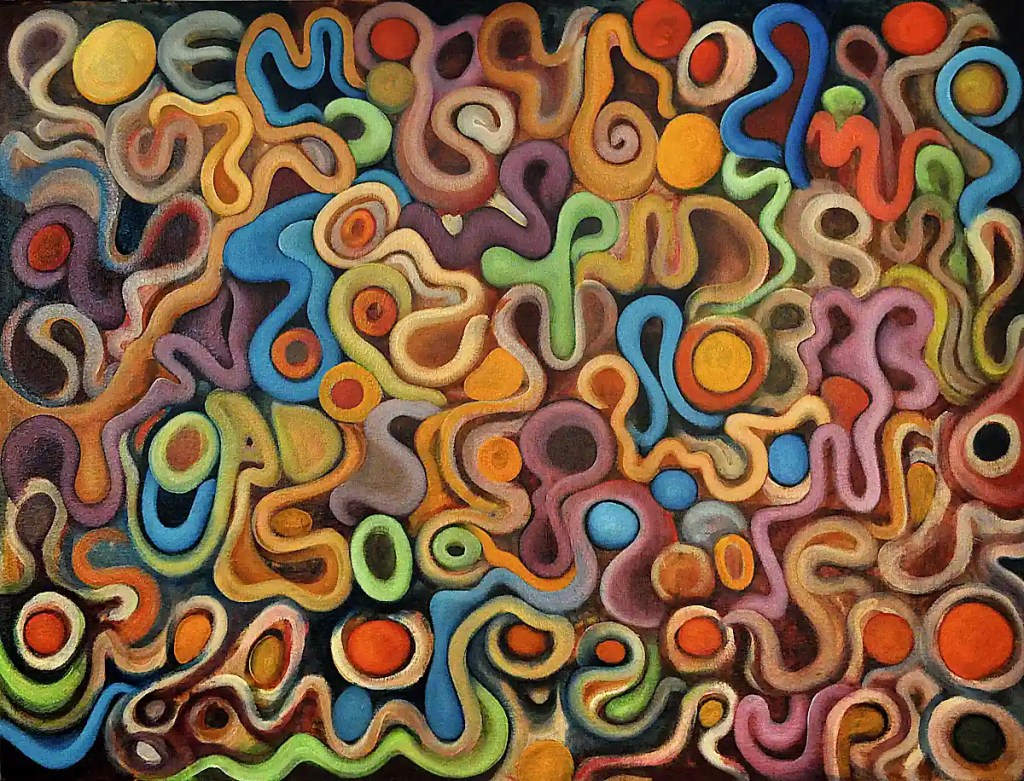
🙂 A glare-free shot of this just isn’t happening. This is a little more “contrasty” than it is in real life.
I got some colors and forms blocked in. Despite what you see here… some of the underpainting’s still there. It’s covered with glazes in spots… still shows the same texture. Most of this is still pretty rough. It needs much modeling and many shadows. Some of the colors are a bit brighter than I’d like so there will be many glazes as well.
Overall, I’m happy with the layout and the sort of “alphabet soup” look of the whole thing. I still have some forms to figure out. Some of them are a little too “simple”. 🙂 I need to add some complexity to the thing. I want to play with the colors as well. It really needs some depth but that will come.
Colors involved: Sennelier’s Cadmium Yellow Light, Burnt Sienna, Sap Green, Naples Yellow Deep, and Titanium White as well as Rembrandt’s Cadmium Red Light and Winsor Newton’s Prussian Blue, Cadmium Yellow Deep and Purple Madder.
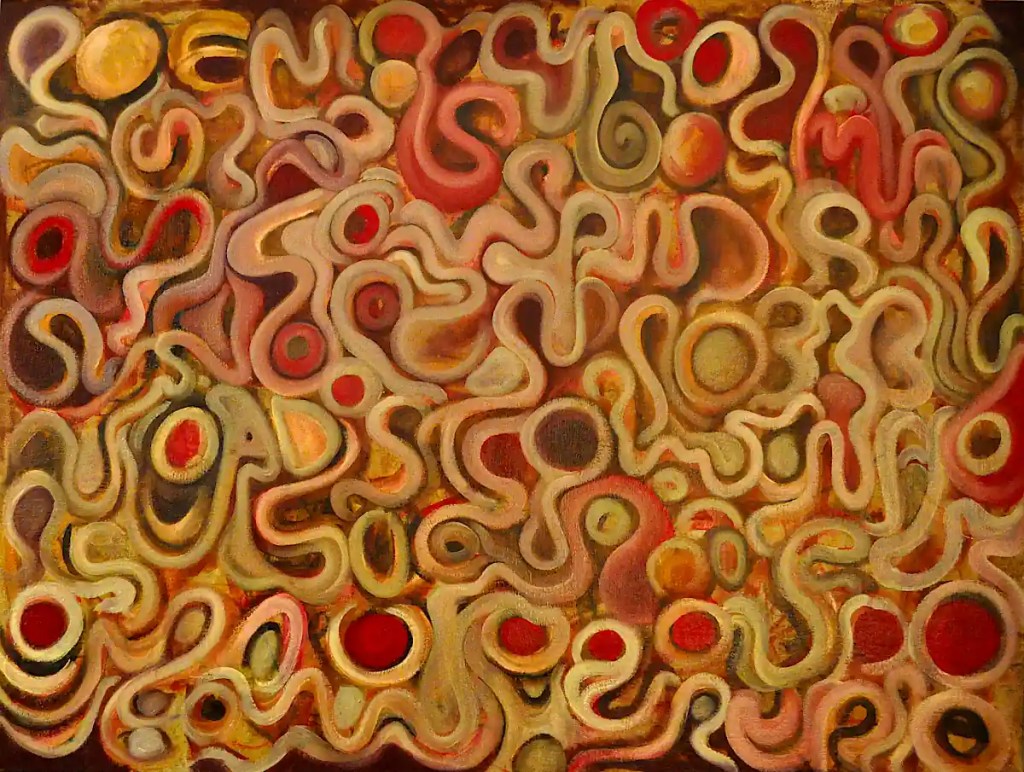
I’m going to call this the first actual painting session. The others were simply to generate a sketch.
I liked the way the Miameri stuff was working, so… I mixed a 50/50ish blob of Yellow Ochre and Titanium White and got out the Sennelier Raw Umber and Caput Mortuum as well as the Winsor Newton Cadmium Red Deep.
I spent several hours listening to “space rock“, adding colors, developing forms and making things work together. I’m much more energized by this than I have been by a painting in quite some time. The only reason I put up the brushes was that the paint started to get a bit thick and “gloppy“.
I’m not a “wet on wet” painter by any stretch of the imagination. I don’t deal well with gooey paint that slides all over the canvas. It’s really rare that I’ll do something alla prima. One of my professors at S.I.U. taught traditional technique… underpaintings, glazes and so on and so forth. I may not adhere to those practices all that faithfully but I do implement aspects of them.
Anyway… this is coming together fairly quickly. I doubt you can see it in this image (A lot of it’s just subtle differences in color… brushstrokes. (“gloppy” 🙂 )) but I do have most of the forms defined. Next… color interactions… refinements and so on…
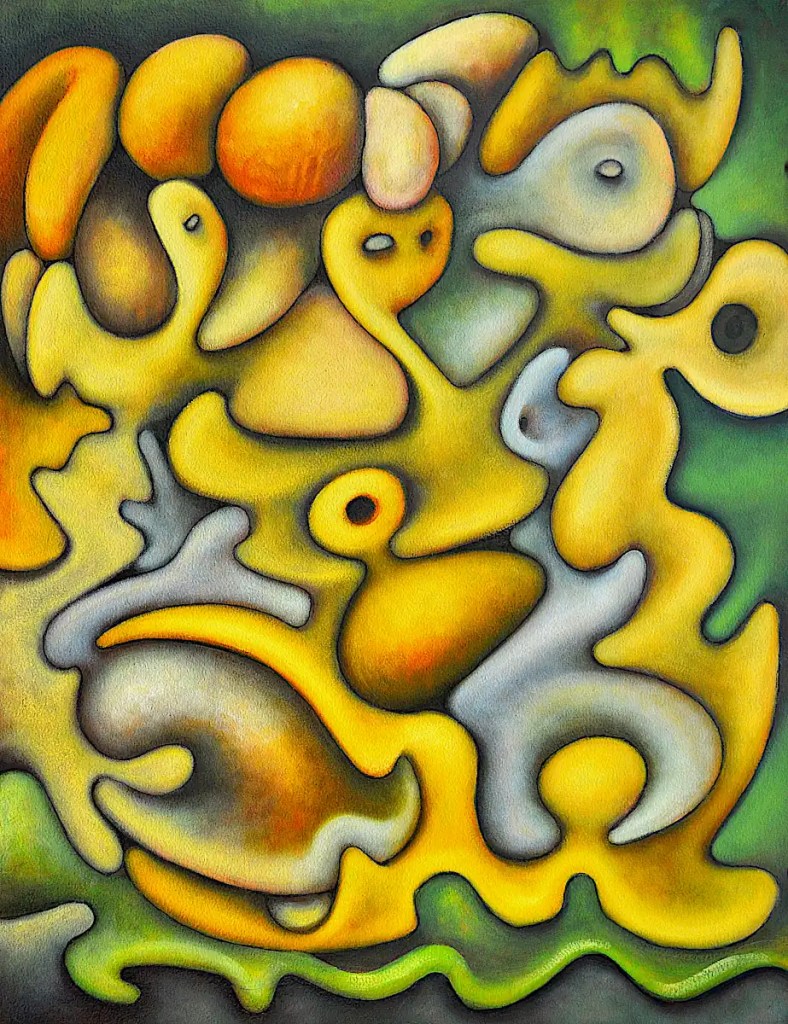
A happy, little dance piece done from an automatic drawing. It’s 24×18 inches… oil on canvas panel.
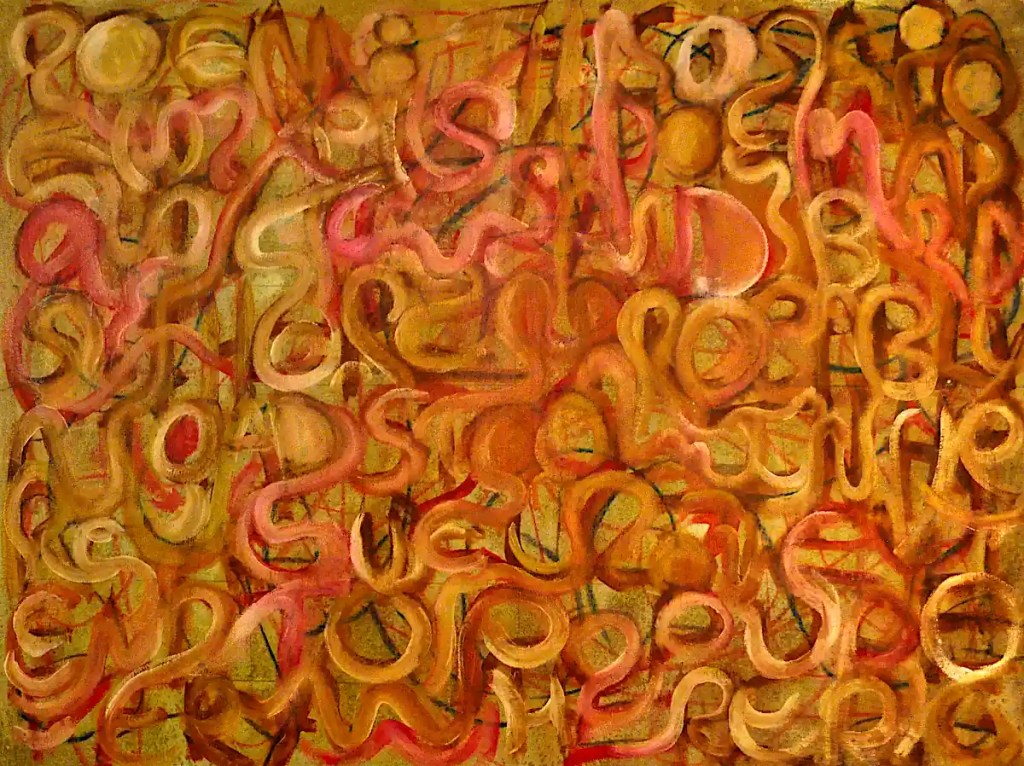
I was gifted a dozen or so pound tubes of Miameri paint when a friend of mine finished her degree at Ray Vogue. They’re student colors (not what I’ve linked to above… It’s just a nice chart of their colors.) and they apparently don’t make them any more. They’re beautiful, just don’t have a huge pigment load. I tend to use them to start largish paintings like this one.
I used a large blob of Permanent Red, Titanium White, Yellow Ochre and Burnt Sienna to do this. I’d intended to stick a little closer to the letter forms and pool “turpentine” (mineral spirits) on top of them so that things blurred and blended and so on. I got carried away as usual. I went ahead and started building some stuff.
I did pool a small amount of linseed oil mixed with mineral spirits and cobalt drier on things… not really as much as I’d originally intended but enough to flatten out the paint film and cause a little blending. I went back an hour or so later and leaned this against the wall (I painted this on the worktable in the garage. I’m fond of breathing.) so that the paint would run down the front. 🙂 I didn’t get as much of that as I wanted either, but… I’m not really wanting to wait a month for this to dry and I want to get started on it, so… I’m going to leave it at that.
You can see some of the “drippage” and bleeding in the detail. Usually, white drips as a sort of veil. You can see a little of that under the “S” form on the upper left.
I’m sort of anxious to see what I can do with this. I like the way the letter forms are working. I may not make as much of an effort to hide them as I’d intended. I rather like the idea of letting them pop out of the painting.
🙂 I’m going to have to do this again.


I managed a few sessions with this while I was waiting for stuff to dry.
This is acrylic; done with Golden’s Alizarin Crimson Hue, Indian Yellow Hue, Cadmium Yellow Primrose and Cerulean Blue Open Acrylics as well as Winsor Newton’s Cadmium Lemon, Cadmium Red Deep and Cadmium Orange. There’s some of Sennelier’s Burnt Umber and Utrecht’s Titanium White in there as well.
I think I’m managing to lose some of the “restroom wall” look and I’m actually starting to like parts of it. I have some ideas as to how this can go (and maybe not end up being totally hokey… It will be weird.). I probably like the “frilly, lace top” more than anything else in the painting. I’m going to have to reproduce some of those holes in the rest of the painting.
This is really just a start. I’ve just blocked in the colors. It should start to take shape when I start using oils.

A couple of days ago, I mentioned that I had an idea for a new image. This is it. At least, this is the beginning.
I know, the first thought that probably comes to mind is “Why the hell would anyone do something like that to a poor, defenseless canvas?”
I intend to generate this image from paint. I wanted consistently sized forms on the canvas. I suppose I could have drawn a grid or filled this thing with row after row of circles. That would have been horribly restrictive and this seemed like a more expressive way of defining things. The forms are roughly the same size and the letter shapes will probably inform the final forms. I have no intention of doing typography here but I’m sure a few elements of the letters will make their way into the final image.
The scribble? It’s to hold things together and begin relationships between the letters. Some of that will probably make its way into the final image as well.
This is done with pastels on unprimed canvas, mounted on a 30×40 inch piece of hardboard. Pastels work wonderfully on raw canvas. You can go through an entire stick in no time though. Raw canvas holds a lot of pigment.
The poem… is nonsense. It does mention toadstools.
(Canvases are hardly “defenseless”.)
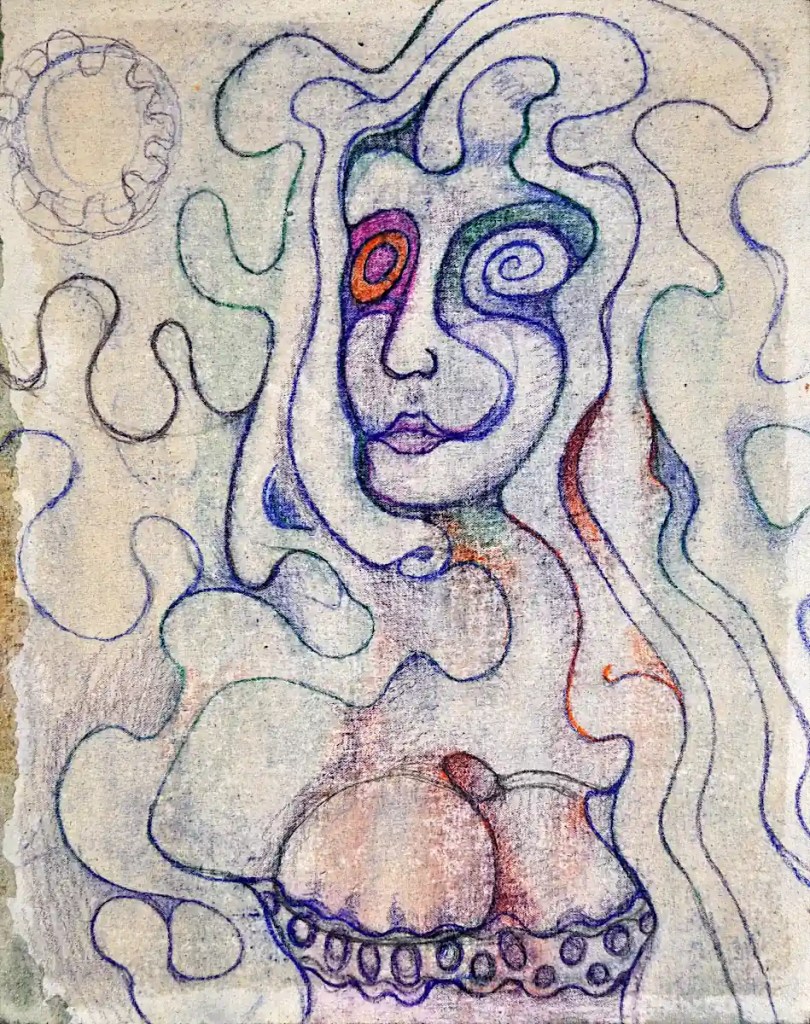
This is the sketch of “A Sunny Day on the South 40” It’s been transferred to a panel and drawn in a bit. It’s unprimed canvas that’s adhered to hardboard with acrylic medium. Basically, it’s going to go straight to paint. This is just to give me an idea of the way things need to work.
I decided that our heroine here… a farm girl caught mid-frolic out in a pasture, wasn’t really likely to be prancing about in the nude. So, in an effort to alleviate a bit of that “drawn on the wall in a service station bathroom” look and make things a little more realistic; I decided she needed a frilly, lace top. I’ve never actually painted a frilly, lace top so we’ll see how that goes. I doubt it will end up being much more than the suggestion of a frilly, lace top.
My graphite paper has given up the ghost after many years of faithful service, so… I transferred this by rubbing pastels on to the back of the print. That always leaves things a little messy. The lines are darkened with watercolor pencil. I’ve shaded things a bit just to get them started… I sprayed it with water to set the drawing, further start the shading process and give me a few random drips. This is wet in the photo.
I’ll give this a coat of clear acrylic a bit later just so it doesn’t soak up huge amounts of paint, sand it and go straight to acrylic for the under-painting. I have some ideas as to how this will go. As usual, we’ll see what happens.
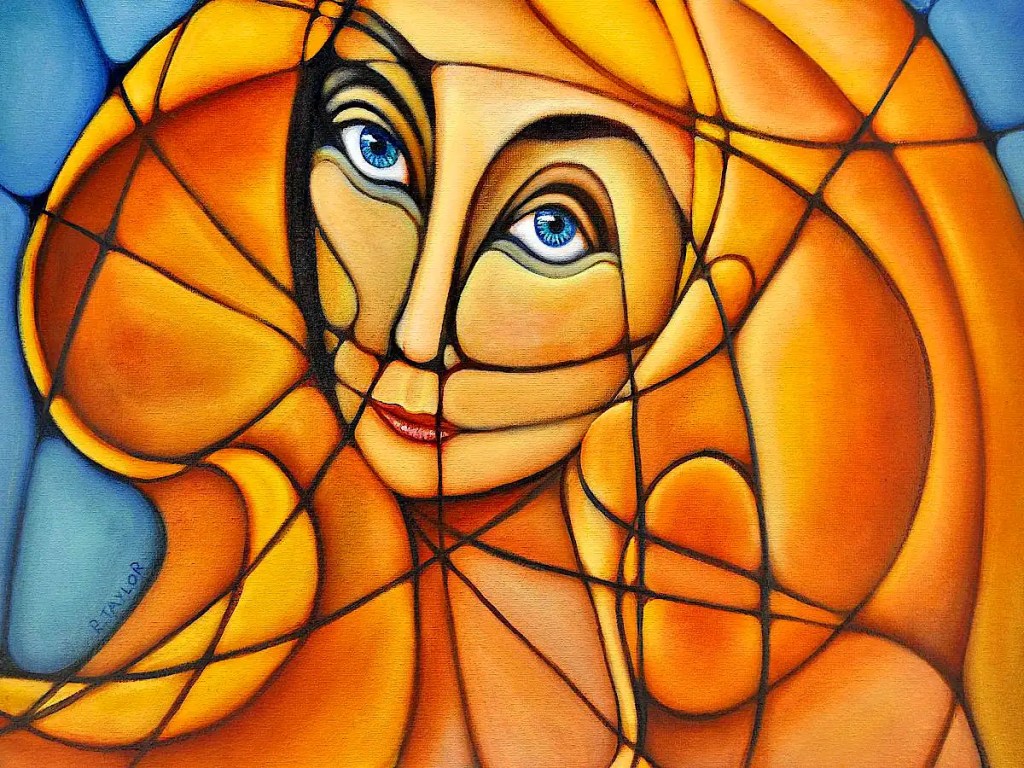
This is another painting based on a photo of Mera. It was featured in a series of “bus stop” benches that the Collective gallery did around the city as a promotion. If you live here, you’ve probably seen it.
As you can probably tell, the “automatic drawing” here wasn’t quite so automatic. It’s closer to a Cubist technique to break things into forms and planes than anything generative.
This is 18×24, oil on commercial canvas panel.
 Studio Time